Book Review by Hank Nuwer
First published in different versions in the Cordova Times and Thestatehousefile.com
See also:
Archival Records Reveal Nazi Party Membership of Kurt Vonnegut Jr.’s Relatives
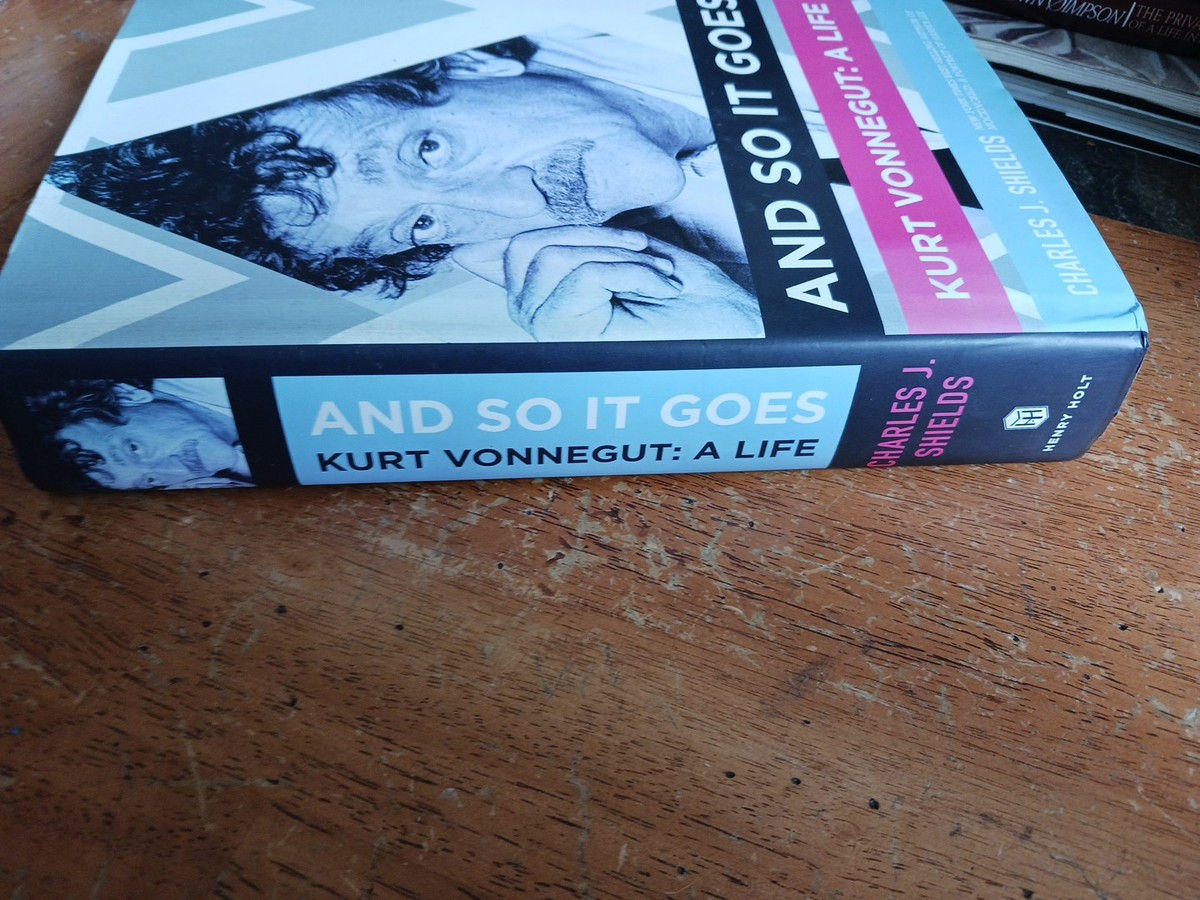 And So It Goes: Kurt Vonnegut: A Life By Charles J. Shields
Reassessment/review by Hank Nuwer, University of Alaska, Fairbanks
Fifteen years following the release of “And So It Goes: Kurt Vonnegut: A Life,” I decided to review the biography by Charles J. Shields.
I was shocked by how many errors jumped off the page. One wonders how the biography’s embarrassing mistakes slipped past former Henry Holt and Co., editor Helen Atsma and Folio Literary Management agent Jeff Kleinman.
I think it is important to note that important changes were made when a St. Martin’s Griffin paperback edition of the biography followed on the heels of the Henry Holt hardback. For one thing, Shields dedicated the hardcover copy to Vonnegut’s longtime friend and magazine editor Knox Breckinridge Burger.
Vonnegut had first agreed to leave his longtime agent and join Burger’s fledgling agency, then ran back his promise. Stunned and financially hurt, Burger never forgave Vonnegut and turned over more than 100 letters to Shields that contributed to the damning portrait of the author in “So It Goes.”
Shields dedicated the hardcover “To Knox Burger: Hang a Gold Medal on him.” Perhaps realizing that dedicating a book to a source looked suspect, Shields removed the dedication from his paperback and dedicated the new edition to his wife Guadelupe.
Also missing from the paperback was a five-page introduction in which Shields revealed that after Vonnegut’s death, Mark Vonnegut refused to grant him permission to quote from hundreds of letters that Shields had picked up privately and from visits to the Vonnegut Collection at Indiana University’s Lilly Library.
In an online blog that Shields shut down without notice one day, Shields openly acknowledged that to obtain his subject’s permission to become the authorized biographer, he promised Vonnegut that he would share any negative references from his interviews with dozens of sources.
That concession, and Shields’ previous largely complimentary biography of Harper Lee, helped convince Vonnegut to name him his authorized biographer despite some initial misgivings by son Mark Vonnegut and wife Jill Krementz. Moreover, while Shields was visiting Vonnegut at his New York townhouse, wife Jill Krementz revealed to the biographer that she was a great fan of Harper Lee’s novels. The latter information is contained in transcripts of interviews with Vonnegut and his wife now found in the Charles J. Shields collection of papers he donated to the Indiana Historical Society.
Shields and Vonnegut chatted several times by phone even as the biographer crisscrossed the country to acquire documents and speak to more sources.
On at least one occasion, Vonnegut hung up on Shields, according to Shields’ notes. On March 13 and March 14, 2007, Vonnegut sat down with Shields for a sad and self-pitying interview. In particular, the author surprised and pleased Shields with his explosive criticisms of his late brother Bernard, a well-known scientist. Shields now had ammunition to spare to gun down Vonnegut.
Vonnegut, of course, fell in front of his townhouse after what turned out to be the final interview on March 14. Shields hurried back to the house to locate some documents that Jill Krementz needed for insurance purposes.
The fall proved fatal. Not only did Shields lose a source clearly warming up to him, but Mark Vonnegut denied Shields the right to quote verbatim from the author’s hoard of letters. At that point, Shields told audiences during a post-publication speaking tour, “all bets were off” so far as sharing any negative source feedback with Jill or other family members.
The biography gained a certain notoriety when it was released Nov. 8, 2011. Biographer Charles J. Shields portrayed the celebrated author in an overall unflattering portrait that Shields vigorously touted “as a definitive biography of an extraordinary man.”
To be sure, some reviewers back in 2011 like Janet Maslin of the New York Times gave Shields a free pass, blind to all the book’s errors. She called the biography “an incisive, gossipy page-turner.” Others, like Los Angeles Times book critic David L. Ulin, judged it “a problematic portrait, sketchy and pedantic by turns.”
Biographers Blake Bailey (John Cheever) and Carol Sklenicka (Raymond Carver) gave “So It Goes” juicy blurbs.
I wonder how closely they read the book.
In fact, the best review of “So It Goes,” in my opinion, was by William Rodney Allen.https://www.vonnegutlibrary.org/wp-content/uploads/2018/02/Rodney-Allen-ARticle.pdf
Let me count the ways the book falls short of what I hoped to read from Shields, the co-founder of Biographers International Organization.

To begin, Shields misidentified Baby Vonnegut’s birthplace address. The birth certificate listed a rental property at 955 North Pennsylvania Street as the home of parents Edith and Kurt Vonnegut. The rental served the parents, older son Bernard, and daughter Alice as temporary living quarters while workmen completed construction of the parental house in 1923, several months after Kurt’s birth on November 11, 1922. That rental property near downtown Indianapolis long ago was torn down. A smoke shop sits there now, appropriate since Vonnegut smoked Pall Malls right down to his last breath before his fatal fall in 2007
Vonnegut’s boyhood home wasn’t completed until 1923. Vonnegut was born Nov. 11, 1922.
Also, Shields lists the Vonnegut home as 4401 N. Illinois St. The correct address of the boyhood house is 4365 N. Illinois St. The address number didn’t change to “4401” until around 1940, many years after cash-strapped architect Kurt Vonnegut Sr. traded his dream house for another home he and his wife could afford..
Shields said the architect who designed the N. Illinois home was William Osler. Nope, he is the “Father of Internal Medicine.” Shields meant Willard Osler. Besides, Shields might have simply glanced at Wikipedia to see that Sir William Osler died three years before Baby Vonnegut’s birth. The team of Lee Burns and Osler, on the other hand, designed many grand Indianapolis homes in the 1920s, including the residence of Kay’s future best man Benjamin Hitz, Jr.
Then there’s a “grave error” by Shields of enormous significance. In the climax of Vonnegut’s classic “Slaughterhouse-Five,” an older American foot soldier is put on trial and shot by a German firing squad for swiping a teapot from a ruined building in bombed-out Dresden.
Vonnegut took creative license here.
“Poor old Edgar Derby,” as Vonnegut described him, was a composite character mainly drawn from an actual POW named Michael Palaia who swiped a jar of string-beans or other food. Taking plunder meant death upon conviction.
Shields writes that Palaia “was one of the older prisoners and unable to withstand the deprivations as well as the younger men.”
PFC Michael D. Palaia was a sturdy, strapping 6’2 youth of 19.
Shields fails to factcheck the date Palaia died. Vonnegut and a few other POWS with him in Dresden wrongly claimed the execution occurred on Palm Sunday, 1945.
Shields writes that a firing squad executed Palaia and a Polish soldier April 1, 1945, Palm Sunday.
An online calendar lists April 1 as Easter Sunday. Palm Sunday was March 25, 1945.
German records note the actual execution as Saturday, March 31, 1945.
Here’s the grave error, far more consequential. Shields writes that Vonnegut was one of four men in the vicinity of the execution who were made to dig a grave and bury Palaia.
No, Vonnegut was not near the execution and learned of it secondhand. Nor did he wield a pick and shovel.
The actual grave diggers were Harry E. J. Kingston, Henry Edward Hall, Joseph Topicz and Floyd T. McLea. The truth was scattered in interviews and commentary by Dresden POWs in the 2008 book “Shadows of Slaughterhouse Five” by Ervin E Szpek, Jr. and Frank J. Idzikowski.
Shields names this book in his list of works cited.
In “Shadows of Slaughterhouse Five,” we learn the real names of the grave diggers from the post-war interviews of military war crime investigators. CIC special agent Joseph Carpenter interviewed Topicz. Special agent William Busch, Army Counter Intelligence Corps, Second Army for the War Crimes office, grilled Kingston. Special agent Joseph S. Smith interviewed former private McLea.
The interviewers also learned that the second prisoner was a Russian, not a Pole as Shields writes.
To be sure, Ginger Strand’s biography “The Brothers Vonnegut” also names Vonnegut as one of the Palaia grave diggers. Less notably, she errs by listing the MIT fraternity of Kurt Sr. as Kappa Sigma. Kurt’s dad actually pledged Delta Upsilon. Why is that important? Because that’s why Kurt became a legacy DU at Cornell University.
It is likely Shields regrets not pressing Vonnegut about the Palaia matter during two interviews at Vonnegut’s New York home. Vonnegut upon his arrival home in Indiana from captivity told his Uncle Alex Vonnegut about Palaia’s demise. It is possible that Kurt claimed to be a grave digger, but it’s also possible notoriously ditzy Uncle Alex wrongly assumed his nephew was present for the execution.
Vonnegut household servant Carrie B. Hatterbaugh is misspelled “Cannie Hatterbaugh,” Charles McKinley Nice and his wife Clare should have been spelled Charles McKinney Nice and Sadie Claire Mapes Nice (Bingham). Vonnegut’s lawyer Donald C. Farber is called a former sergeant. His military records and wedding announcement have him a PFC.
In Chapter One, Shields writes about young Kurt’s relationship with African-American cook Ida Young.
Shields portrayed Ida Young as a “widow” when she worked for Edith and Kurt Vonnegut. Ida Young didn’t become a widow until Owen, 57, died on February 3, 1935, long after she left the Vonnegut family.
Shields writes that Vonnegut enlisted in the U.S. Army in March of 1943. Vonnegut’s service record notes his enlistment as April 6, 1943.
Then, Shields wrote that Kurt married first wife Jane Cox on Sept. 14, 1945. Uhuh. Due to a change in plans, the wedding took place Sept. 1, 1945.
Shields claimed Vonnegut’s parents attended the wedding of Irma Vonnegut (sister of Kurt Sr.) in Germany in 1924, leaving young Kurt with relatives.
Nope. Irma Vonnegut married Kurt Lindener on August 18, 1922.
His pregnant mother and father didn’t attend the wedding. Kurt wasn’t born until Nov. 11, 1922, and so he sure wasn’t left with anyone.
The Vonnegut parents did sail to Europe in 1924 to visit the Lindeners and their son Arthur.
Also, Lindener’s wealth at the time came from vast Guatemala coffee and sugar plantations. Shields placed the plantations in Honduras, ignoring travel documents, news clippings, and government documents.
Next up, Shields quotes Vonnegut’s wartime pal Bernard O’Hare describing their capture during the Battle of the Bulge and crying “Don’t s_ _ _” instead of “Don’t shoot!”
However, Vonnegut assured O’Hare’s widow the story was untrue nonsense.
Some other errors by Shields can be traced back to errors by Kurt Vonnegut in his autobiographical writings, including excerpts in “Palm Sunday” taken from an opinionated family “history” by “Uncle” John Rauch, a Vonnegut relative by marriage.
Shields repeats a misspelling by Vonnegut and Rauch of the last name of Charles Volmer, an Indianapolis merchant who persuaded boyhood friend Clemens Vonnegut Sr., Kurt’s great grandfather, to settle in Indianapolis and open a shop with him. Vonnegut, Rauch and Shields write “Volmer” as “Vollmer,” ignoring several city directories of the period.
Moreover, after the financially strapped Volmer and Clemens ended their partnership, the ex-partner did not immediately head for the California gold fields as Shields, Rauch and Kurt presumed. Even a cursory look at readily available city directories list Volmer as the owner of another Indianapolis business in 1861.
Shields, Rauch and Vonnegut all got a single important fact wrong about Kurt’s maternal grandmother, Alice Barus Lieber, who died of illness at 30 on Dec. 10, 1897.
Rauch and Vonnegut wrote she died during childbirth with Vonnegut uncle Rudolph Vonnegut. Wrong, Uncle Rudy was born Jan. 5, 1896.
Shields writes incorrectly that Rudy was 5 when Alice died.
Kurt Vonnegut Sr. died Sept. 30, 1956, of lung cancer after a lifetime of smoking. Shields claims ”no one came to check on him regularly” except a nurse. But sister Irma Lindener flew from Germany to Indianapolis in late July of ’56 to attend to his needs.
We find several errors by Shields in Chapter Six, “The Dead Engineer.” Kurt’s sister Alice lay dying of cancer in a hospital, her husband James Adams dies when his commuter train sailed through an open bridge into Newark Bay.
Unfortunately, the biography’s footnotes reveal that Shields relies too much on an early newspaper account of the tragedy. Later articles contain information based upon investigations by authorities. Those accounts contradict some assertions by Shields.
Most prominently, Shields writes that the train engineer died of a heart attack while the fireman alongside him wasn’t able to halt the train.
No, in fact a pathologist ruled out a heart attack, and experts could not say with certainty if the engineer was incapacitated at the fatal final moments.
Moreover, the inquiry found the fireman had left his post, leaving the engineer alone. Finally, Shields has a car staying on the tracks in safety. Newsreel footage shows two cars spared.
The worst is yet to come.
Here it comes.
After the deaths of Vonnegut’s sister and brother-in-law, Kurt and wife Jane took in their sons James Jr., Steven and Kurt. Shields introduces an older sister of the late James Adams. Shields writes this woman was well off financially and helped with bills incurred by the boys.
What Shields does next is mystifying. The aunt of the boys is Louise Adams Donner, also known as Mrs. Carl Donner. She is an important source for Shields in that she was critical of Kurt and Jane.
For no reason I can see, Shields changes the name Louise Adams Donner to the pseudonymous “Donna Lewis.” Shields refers to Carl Herman Donner as “Carl Lewis.”
Two footnotes cite an interview with “Donna Lewis” on July 27, 2008. Neither footnote explains why the biographer obscures her identity.
I consulted the Charles J. Shields papers at the Indianapolis Historical Society to examine his interview with Louise Adams Donner, aka “Donna Lewis.”
Shields discloses that his phone interview with her went awry. He neglected to tape her side of the interview. Instead of conducting a second interview, Shields (in his papers) reveals that he relied on his recollection for what the aunt said.
Another big surprise at the Indiana Historical Society was a letter from Shields after Vonnegut’s death to author John Updike. The biographer wrote that he was having trouble getting a handle on how best to tell his subject’s story.
Moreover, confessed Shields, he was no fan of Kurt Vonnegut’s books. He said he wanted to throw two of his subject’s novels across the room when he read them.
Also, Shields confides he told Kurt Vonnegut he would share negative information that came out in interviews with various sources.
To me, that’s hagiography or ersatz biography, not a biography of a well-known novelist.
But when Vonnegut died, Shields declared that promise no longer held.
“I don’t mean to sound ghoulish, but isn’t that the ideal situation for a biographer, to have your subject cooperate happily with you, and then die, leaving you a free hand,” Shields told an interviewer.
Shields’ blistering biography certainly changed the world’s impression of Kurt Vonnegut, as well as my own impression of Vonnegut formed during a long interview, luncheon, and also an accodental evening together at a bar in New Hampshire the night each of us gave separate lectures at the University of New Hampshire.
“So It Goes” portrays Vonnegut as a skirt-chasing, grouchy, adulterous wreck of a man and something less than a genius as an author.
Here’s Shields describing “Slapstick”: “As the novel doggedly continues, one gets the feeling that he is writing to cheer himself up with wild scenarios but then he returns to castigating the selfishness and behavior of people who should know better. The result is a relentless list of woes. When the last sentence arrives, `And so on,’ the reader is tempted to agree, `Whatever.’”
But therein lies another big fault in the biography. Shields never should have padded the biography with paragraph after paragraph of what amounts to literary criticism. Shields, who self-describes himself as a “literary biographer,” lacks the true critic’s vocabulary, as well as the sensibility, to do justice to criticism. Vonnegut scholars Peter Reed, Jerome Klinkowitz and Robert Merrill do a far better job interpreting the author’s prose.
Shields writes of the death of Kurt’s mother Edith and accepts Kurt’s word that she died a suicide. The biographer’s interviews with Kurt’s children were skeptical that she intentionally killed herself.
Indeed, Shields had venom to spare after skewering Vonnegut in the hardcover’s intro and in the text of both bios. He refers to Kurt’s patient, elderly agents as “gasbags,” although they protected Vonnegut when short stories came back with rejection slips.
Shields then appears to be a spokesman for Burger. When Vonnegut first agrees and then reneges on a promise to Burger to dump his old agents and sign with Burger, that preachy side of Shields comes out as he paints Vonnegut as a false friend.
Isn’t it possible Vonnegut backed out because Burger was a good editor but never shy about giving his brusque two cents after reading Vonnegut’s manuscripts?
Vonnegut as a struggling newcomer was in no position to do much more than grouse before making all the changes Burger demanded. Perhaps Vonnegut’s pride wouldn’t let him sweat under Burger’s thumb again, which was a mistake on Vonnegut’s part. Burger would have helped the author clean up weaker novels like “Hocus Pocus” and “Slapstick” before they went to press.
Shields was so enamored of Burger, later an editor at pulpy Gold Medal publishing house, that he unwisely dedicated the hardcover to his deceased benefactor, along with a corny pun, “Hang a Gold Medal on him.”
Shields deleted the obsequious dedication to Knox Burger in the paperback version of “And So It Goes.” Perhaps the biographer, his editor, or both saw at last the ethical conflict of dedicating a book to a primary, less-than-impartial source. Shields then changed the dedication in his paperback edition to his wife Guadalupe.
Shields saves his neurotoxix venom for Vonnegut’s second wife Jill Krementz, an accomplished photographer, who the biographer savages as bitchy, neurotic and unlikable. And who refused to speak to Shields on the record, although she conversed with him off the record during two visits to the New York townhouse she shared with Kurt. In fact, the last photo of Kurt Vonnegut was one of the author and biographer Charles J. Shields seated nearly cheek-to-cheek–as directed by Ms. Krementz.
It was instructive for me to read numerous transcripts of the biographer’s interviews with sources like Vonnegut’s daughter Nanny and see how he steered the conversation when bringing up Krementz.
Again and again, he approached the topic by allowing how he was trying to be fair with Jill but try as he might he found very few people who liked her.
A judge would have tossed him out of a courtroom for leading the witnesses, but it worked the way Shields intended. Inevitably, each source babbled some new harsh tidbit about the photographer that allowed Shields to cast her as a harpy from hell.
When Jill declined to go on the record, Shields wrote her a letter, to me rude and unseemly, where he advised her to talk with him because so many of his sources framed her in negative terms.
In an interview with one of Vonnegut’s daughters, Shields complained that he had a phone conversation with Krementz that annoyed him because she said she was speaking from the comfort of her bed and referred to him as dear.
Yet, Krementz told New York magazine that she always likes to talk on the phone in bed, while she browses through magazines. And women of 86-year-old Jill’s age routinely call men “dear” or “honey.”
Moreover, that prissy, prudish, intolerant side of Charles J. Shields jumps off the page now and then in “So It Goes.”
“Still on the prowl, a few weeks later Vonnegut found another woman to bed, a former student at Iowa,” wrote Shields, naming her.
And when Kurt and Jill attend a huge feast at a party for Craig Claiborne attended by 36 chefs and a boatload of celebrities, Shields knocks himself out with irate indignation: “a good example of the disconnect between the values (Vonnegut) espoused and the life he was living.”
The hardcover edition of the biography contained a self-indulgent introduction that raised the eyebrows of reviewers such as David L. Ulin.
Shields said that he tried convincing Kurt to let him be his authorized biographer by praising Kurt’s books as “part of the literature that guides and inspired the next forward-looking age.”
In another letter, Shields told the author, “And I’m a damn good researcher and writer.”
Vonnegut wrote back “OK” on a postcard and had himself a biographer.
Shields removed the introduction from his paperback but neglected to delete references in that intro in his less than all-inclusive index. So, for example, a reference to John Updike on page 5 takes you instead to a blank page.
The bulk of Vonnegut’s quotations and paraphrased words given to Shields came the last two days of Kurt’s life. Jill Krementz even snapped a photo of Shields and Vonnegut seated cheek to cheek.
Shields describes the author as unhealthy appearing, and indeed, Vonnegut’s last utterances sound morose and whiny. Shields puts himself in the book’s final chapter and coyly refers to himself as “a visitor.” We learn that Kurt curtly hung up on a caller, but we only learn the caller was Shields in a talk the biographer gave.
Shields left the brownstone after the session on March 14, 2007, and that evening learned that Vonnegut had fallen while outside and was unconscious. Shields put that in his notes.
Later, in his biography, Shields dresses up the story by saying Vonnegut tripped over his white dog Flour’s leash.
That may be a shaggy dog story. The good citizen who saw Vonnegut on the pavement gave neither his name or too much detail in a 911 call. A footnote lists the biographer’s source for the leash story as a “summary of interviews with Lily Vonnegut, Edie Vonnegut, and Knox Burger.
None of the three saw Vonnegut fall.
The biography ends with the celebrated author’s death April 11, 2007. Somehow, the biography’s mistakes slipped past former Henry Holt and Company editor Helen Atsma and agent Jeff Kleinman.
In closing I should say that Shields was an indefatigable researcher. His biography does have value. And his interviews with dozens of sources stored at the Indianapolis Historical Society will spawn dozens of scholarly articles and books, including my own scholarship on Vonnegut.
I sent an email to Charles J. Shields to ask him for an interview. He sent an email back to decline discussing the Vonnegut bio.
I wanted to ask the biographer about Mark Vonnegut’s charge that “So It Goes” was “a book whose existence is completely and utterly dependent on a picture that Shields would have made up out of whole cloth if he had to.” (Disclosure: I interviewed Dr. Vonnegut before the Shields bio came out).
Perhaps “So It Goes” could be worse, could contain more factual errors and self-righteous pronouncements. But, for the life of me, I don’t see how.
Hank Nuwer is an adjunct professor at the University of Alaska, Fairbanks, a member of Biographers International Organization, and a professor emeritus with Franklin College’s Pulliam School of Journalism. This review first appeared in The Cordova Times.
PS.
I am now reading some reviews of other books by Mr. Shields on Good Reads and find it surprising how Charles J. Shields bites the writing hand of his readers who criticize his biography of Lorraine Hansberry. He condemns what he calls cancel cluster. –Hank Nuwer
This excellent article appeared in Brevity magazine.
I also liked the biographer we see in the following post by author Maud Newton.
