Categories
Hazing News

Buffalo News reporter gains insight from parents on death of their son

Moderator:  Once again, a hazing tragedy was caused by a bottle exchange between a pledge and a senior member.  If this one custom could be abandoned, we would save so many lives. Link to an outstanding article, but very sad.  Excerpt:

Growing up in Amherst, Nolan M. Burch seemed to make friends everywhere – in the Briarhurst Park neighborhood where he lived, in local hockey and baseball leagues, and at Canisius High School.

So when the gregarious 17-year-old with the mop of dark hair and giggly laugh told his parents he was joining a fraternity at West Virginia University, they figured it was just a new way for him to make even more friends on the large, hilly campus overlooking the Monongahela River.

“I just thought it was another thing he was joining … another thing he wanted to be a part of, like hockey or baseball or whatever,” said his mother, Kim Burch. “I didn’t think anything of it.”

Nolan’s father, Theron J. “TJ” Burch, said it “seemed like a regular part of college life.”

It’s hard for the Burches not to have a dim view of fraternities now. A year ago their son died of heart failure stemming from extreme intoxication, following a boozy initiation ceremony for pledges seeking membership into Kappa Sigma fraternity. Since his death, the Burches have launched a foundation in their son’s memory and sued the university and the fraternity. Inside the living room of their Amherst split-level home this week, they shared intimate details about Nolan’s young life and revisited the events surrounding his tragic death in Morgantown, W.Va. They point to the collage of class pictures of Nolan, from kindergarten through his senior year of high school, and to the seat in the dining room where Nolan would study for a big exam, sometimes until 11 p.m., still wearing the tie required at Canisius.

TJ Burch described the loss of his son as an inexplicable numbness and sadness “that’s always there.”

“We want him to be remembered, that’s one part of it,” he said. “But we don’t want anyone else to go through this.”

Dangerous rituals

Nolan’s death was one of at least seven hazing-related deaths across the country in 2014, according to Hank Nuwer, who teaches journalism at Franklin College in Indiana and has chronicled hazing incidents for years.

Nuwer’s website lists 210 hazing-related deaths, mostly on college campuses and mostly involving fraternities, dating back to 1838.

Some of the deaths sparked major reforms in how colleges, universities and Greek organizations handle hazing. But while national awareness of the dangers of hazing has grown, alcohol-fueled initiation ceremonies persist on many campuses.

“There’s a craving among young people for these rites of passage,” said Nuwer, a Buffalo native and graduate of SUNY Buffalo State who has written four books on hazing.

Categories
Hazing News

Blockbuster News: Sig Ep claims it cannot be sued in death of Tucker Hipps

Moderator:  This is an important update from today’s Greenville online. Excerpt below.

“Attorneys for Sigma Phi Epsilon argued that the Clemson chapter of the fraternity was dissolved on Feb. 6, nearly two months before the family [of late pledge Tucker Hipps] filed the lawsuits, and that as a “non-existent legal ghost,” it can’t be sued.

It cites a 1991 case in Delaware in which that state’s Supreme Court ruled that a fraternity member who was injured while he was a member couldn’t sue his fraternity after its charter had been withdrawn. But it said individual members could be sued.

Motions for dismissal were filed by the national fraternity and former Clemson SigEp members Campbell Starr, Samuel Carney and Thomas Carter King.”


Categories
Hazing News

Commentary: West Virginia Phi Gamma Delta chapter tests new Greek supervisor

Moderator:  It has been my honor and privilege over the years to have worked with many many great Directors of Greek Life and also individual chapter advisers.  One of the leaders I have known the longest is Roy Baker who has served with distinction all his career at Bucknell, Syracuse and Penn State–all three where I have lectured on hazing prevention. In my estimation, he is all an administrator would want in a leader: tough, fair, consistent and concerned for the growth, safety and well being of his students.

He sent me once a letter after one of my talks in which he said a sorority saved the life of a member by calling 911 a couple days after my talk. A member told him my talk had inspired the women to face trouble and call for help rather than delay and possibly lose one of their own.  It is one of the letters I most treasure in my own career that began in the 1970s.

On November 1, Dr. Baker began his duties and West Virginia University. I had dropped him a note to congratulate him. Now, according to a news story, it looks as if the Fiji chapter at WVU cavalierly has decided to test boundaries with the new director. According to local TV reports, “Christopher Grace, 21, of Arlington, Virginia was found Wednesday at about 11:30 a.m. bound with duct tape. Investigators say the victim and fraternity members showed minor injuries from an altercation. And, according to police, Grace was being shoved in the trunk of a car.”

Big mistake. West Virginia is already reeling from the death of Kappa Sigma pledge Nolan Burch, a young man who grew up in a Buffalo, NY suburb not far from where I was born and reared. And the subject of my 1990 book “Broken Pledges: The Deadly Rite of Hazing” was Klan Alpine pledge Chuck Stenzel, son of well-known hazing activist Eileen Stevens, who died at the Alfred University following an incident in which members kidnaped him, stuffed him in a car trunk, and coerced him into drinking a lethal amount of alcohol. (Klan Alpine was abolished at Alfred University, and now AU is known for its published research on hazing conducted by another old friend and colleague of mine, Dr. Norm Pollard).

A similar kidnaping and car stuffing years ago nearly claimed the life of a University of Michigan hockey rookie who fortunately was hospitalized just in time. So, this “prank” is more than a prank. It is a bonafide hazing incident, and I have no doubt PhI Gamma Delta’s national will also lower the boom on its WVU chapter for this stupid stunt.

If the news article is correct, the offending chapter soon will learn that its old ways now are its past ways.

Welcome to WVU, Dr. Baker. WVU is a great school with many distinguished faculty.

Here is the story link.
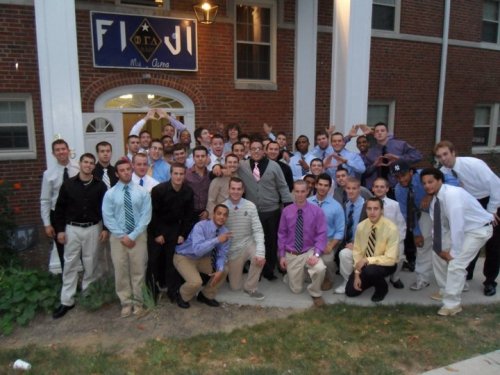
WVU FijiWVU Fiji

The article says this:

 “One of our plans will be to make sure that students at the university, parents at this university, know before they join a fraternity or sorority, if that chapter had been involved in issues whether it be hazing, alcohol education, sexual assault, any of those types of things,” he said.
 
“Baker says the university has a lot of work to do, and they will use Wednesday’s incident as a learning tool to prevent future problems.”
You can take Dr. Baker’s word that this is so.
Postscript: WVU released the names of FIJI members charged by local police. Here is the statement in part:
Upon further investigation, officers found that the entire incident was part of a fraternity prank for the Phi Gamma Delta (FIJI) fraternity. All of the below listed individuals involved are pending charges for disorderly conduct.
  • Luke Russillo, 18 years of age of Smyrna, Delaware
  • Joseph Russillo, 18 years of age of Smyrna, Delaware
  • Chadwick Miller, 18 years of age of Sewell, New Jersey
  • Matthew Kinker, 19 years of age of Crystal Lake, Illinois
  • Tyler Audette, 18 years of age of Massapequa, New York
  • Austin Harpin, 21 years of age of Feeding Hills, Massachusetts
  • Cody Heffelinger, 18 years of age of Coopersburg, Pennsylvania

Categories
Hazing News

Teen, falsely accused in sport hazing, sues to clear his name

Here is the link.

Categories
Hazing News

Article claims universities turned a blind eye before deaths occurred

Here is the link and an abstract


‘Occurrences of concern’

Nowhere on West Virginia University’s website did it say that Kappa Sigma fraternity had a history of, as the school now puts it, “occurrences of concern” — specifically referring to the fraternity “behaving inappropriately and hosting an unsanctioned event.” The fraternity was also warned about overcrowding in its off-campus residence.

Burch, a WVU freshman, died following a fraternity hazing event in November 2014. His blood alcohol content was measured at 0.493, more than six times the legal limit to drive. His death led to the suspension of all Greek activities at WVU and criminal charges against two Kappa Sigma brothers.

Two days before the event, where police say Burch and others were blindfolded and forced to drink liquor, the national office of Kappa Sigma notified WVU that it was pulling the charter of the local fraternity chapter. According to a statement given to CNN, the national office directed the local chapter to stop holding functions. But that directive was ignored, according to the fraternity’s national office.

“They’d been in so much trouble they (the national office) put cameras in the fraternity house,” Burch’s mother, Kim Burch, told CNN. “The frat actually installed cameras.”

CNN Investigations

Email your story ideas and tips to CNNtips@cnn.com.

Kim and T.J. Burch say their 18-year-old son was not aware of the fraternity’s troubles when he decided to pledge. No one told him, and no one told his parents either.

“We had no idea, unfortunately, until Nolan passed, that there had been so many problems,” Kim Burch said. “It’s sad. It’s really sad. If we had known this was going on, we would have never let him join this fraternity.”