Lesson Plan: October 15:
Current Events:
Summary: I found two different approaches to covering President Trump’s misinformation at the Wasilla rally regarding sales to South Korea. One took a more tactful approach. The second was accusatory right from the lead sentence.

WASILLA — President Donald Trump sought to boost Alaska’s Republican candidates during a rally in Wasilla on Tuesday, in part by touting foreign investment in a long-sought natural gas pipeline.
Trump’s promises to bring the project to fruition have become the centerpiece of his efforts to boost U.S. Sen. Dan Sullivan, a Republican incumbent who is locked in a competitive race with a well-funded opponent, Democratic former U.S. Rep. Mary Peltola, who received more votes than Sullivan did in the open primary.
Trump doubled down during the rally on an announcement he made earlier this month that South Korea had agreed to spend $50 billion on the construction of a natural gas pipeline in Alaska, a claim that Korean officials have refuted. Trump also announced during the Wasilla rally that Taiwan agreed to buy 30% of the liquefied natural gas produced through the project, and invest $4 billion in pipeline construction.
“All week we were working with the Taiwanese government, and they agreed to buy 30% of everything produced on that line, and they will invest $4.4 billion on top of the Koreans to make sure this line gets built,” said Commerce Secretary Howard Lutnick, who briefly appeared on stage with Trump in Wasilla.
Donald Trump, who lied dozens of times during his speech in Wasilla,
repeated his falsehoods about the gas pipeline Tuesday and claimed that all
the money to build the project is “already committed.”

That is not true.

South Korea has not agreed to provide the $54 billion that Trump and his
employees claimed South Korea approved in time to help Sen. Dan Sullivan
claim credit for getting all the money needed to build the gas pipeline.
Cornell University, Ukraine crisis, Fort Hood killer’s execution
For Critical Thinking: For over two centuries now, the public has argued over what is the thin line between hard news and sensationalism.
Current events:
BBC: US President Donald Trump has said he thinks “it’s time for Ukraine to get a new president” as he responded to Volodymyr Zelensky’s criticism of the US diesel deal with Russia.
The Ukrainian president warned a new deal to release millions of tons of Russian diesel into the US would provide Moscow with money to continue its war against his nation, calling it a gift to Russian President Vladimir Putin.
Trump told reporters outside the White House on Saturday that Zelensky “wants to make problems for the world” by continuing to authorize attacks on Russian refineries.
“He’d better damn well stop,” Trump said, before suggesting Ukraine should “get a new leader who can make a deal.” Since Russia invaded Ukraine in 2022 the country has been under martial law, meaning elections are suspended.
Global fuel supplies, including diesel, have been severely limited by the war against Iran launched by the US and Israel, which led to the effective closure of the Strait of Hormuz, through which roughly a fifth of the world’s oil products usually flows.
Russia – a major producer – and Ukraine have recently intensified their strikes on each other’s energy infrastructure and transport facilities, further straining energy markets.
“We said, ‘you can do whatever you want to Russia, don’t hit the refineries’, because that’s a world problem that’s caused,” Trump continued.
INDIA:
Thousands of young people tried to gather to protest a sweeping revision of their country’s voter roll. Security forces hauled many of them away. –New York Times
The capital of the world’s largest democracy turned into a fortress Saturday, as an extraordinary show of force by Indian authorities met an equally extraordinary display of defiance by the country’s young.
Throughout the day, thousands of people, mostly in their 20s and 30s, tried to gather in Delhi to protest a sweeping revision of their country’s voter roll. Security forces hauled them away, sometimes grabbing them by their arms and legs, and stuffed them, often forcefully, into buses and vans.
Those detained banged on the doors of police vans. They shouted from the windows of buses. One police officer was seen grabbing a protester by the throat. By early evening, more than 2,000 people had been detained, according to a lawyers’ group providing legal aid to the detainees, though an exact number was impossible to ascertain.
The leaders of the Gen Z movement that called for the protest, the Cockroach Janta Party, said they, too, had been detained, including Abhijeet Dipke, one of the movement’s founders.
Last Friday our discussion was the darker side of journalism history.
Today we’ll discuss the importance of journalism in a free society.
Other democratic nations believe in free speech and a free press as well:
Freedom of the press in Canada is constitutionally guaranteed under Section 2(b) of the Canadian Charter of Rights and Freedoms, which protects freedom of thought, belief, opinion, and expression, including the media
USA: “Congress shall make no law respecting an establishment of religion, or prohibiting the free exercise thereof; or abridging the freedom of speech, or of the press; or the right of the people peaceably to assemble, and to petition the Government for a redress of grievances.” Freedom of speech is just one of FIVE core freedoms. Also protected: religion, press, peaceful assembly, and challenging the government.
In your lives, you no doubt have seen some examples of free speech, perhaps without giving what you observed much thought.
If you participated in a protest or observed others protesting, say in a No More Kings gathering, you’ve seen free speech in action.
Some forms of protest had to be fought for. And some persons who normally believe in free speech might be offended by some types of free speech
1968 Mexico Olympics
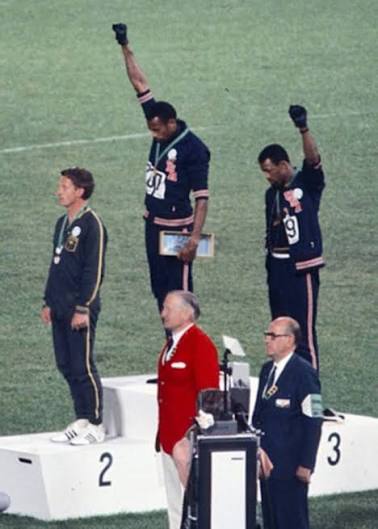
As you were growing up, SF football quarterback Colin Rand Kaepernick and others took a knee during the national anthem as a protest of protest over conditions for African-Americans in the USA. What was the effect on his career?
HISTORICAL EXAMPLE: Students fought back in Iowa when they were punished for wearing black armbands.
From the web site US Courts:
At a public school in Des Moines, Iowa, students planned to wear black armbands at school as a silent protest against the Vietnam War.
When the principal became aware of the plan, he warned the students that they would be suspended if they wore the armbands to school because the protest might cause a disruption in the learning environment. Despite the warning, some students wore the armbands and were suspended.
During their suspension, the students’ parents sued the school for violating their children’s right to free speech. The U.S. District Court for the Southern District of Iowa sided with the school’s position, ruling that wearing the armbands could disrupt learning.
The students appealed the ruling to the U.S. Court of Appeals for the Eighth Circuit but lost and took the case to the Supreme Court of the United States.
In a 7-2 decision, the Supreme Court’s majority ruled that neither students nor teachers “shed their constitutional rights to freedom of speech or expression at the schoolhouse gate.” The Court took the position that school officials could not prohibit only on the suspicion that the speech might disrupt the learning environment.
The dissent argued that the First Amendment does not grant the right to express any opinion at any time. Students attend school to learn, not teach. The armbands were a distraction. School officials, acting on a legitimate interest in school order, should have broad authority to maintain a productive learning environment.
Decision became known as Tinker vs. Des Moines. Protesters were Mary Beth and John Tinker, 1975.
With journalism, we are considering First Amendment protection of free speech to ensure notable WATCHDOG JOURNALISM. Define or examples?
Watchdog journalism is important but not perfect. Can’t make up facts, for example, to end a politician’s career. Stories must be 100 percent factual. Journalists themselves disagree on such hot button issues as the use of anonymous sources.
Today we will also note names to know: some heroes and some journalism stars a mixture of heroism and villainy.
But all these names are important in the development of modern newspapers.
Journalists who made a difference: 1887 –A New York reporter named Nellie Bly posed as a mental patient to expose conditions in a New York mental hospital. It also turned into a discussion of gender inequality. “Difficult women”
Nellie Bly was the pen name of Elizabeth Cochran.
10 days in a Blackwell’s Island asylum outside Manhattan (now renamed Roosevelt’s Island). Undercover journalism. What was the word that started as a negative term for undercover reporting?
- Why would a reporter go underground and experience the cold baths, medications, abuse and squalor? Journalism that matters.
- Note taking: Why was it important neither hospital staff nor patients know Nellie Bly’s true identity?
OCT. 16, 1887 Dispatch: Nellie Bly’s Experience in the Blackwell’s Island Asylum. – CONTINUATION OF THE STORY OF TEN DAYS WITH LUNATICS. – How the City’s Unfortunate Wards Are Fed and Treated. – THE TERRORS OF COLD BATHS AND CRUEL, UNSYMPATHETIC NURSES. Attendants Who Harass and Abuse Patients and Laugh at Their Miseries.
- She did other stories such as circling the world in 72 days. Filing DISPATCHES.
- World War One: Front lines of Europe: World War One.
- Obituary. https://archive.nytimes.com/www.nytimes.com/learning/general/onthisday/bday/0505.html
Nellie Bly’s publisher: Joseph Pulizer: New York World
PBS: Joseph Pulitzer emerges as the country’s first media titan, reshaping the newspaper to bear witness to and even propel that transformation. Joseph Pulitzer tirelessly championed what he regarded as the sacred role of the free press in a democracy.
IMMIGRANTS: Then and now.
William Randolph Hearst: another famous publisher. Enormous wealth. 115-room home.
On one hand, sensationalism and yellow journalism.
On the other, corporate greed, unfair working conditions, child labor, corrupt politicians.
Direct competitor of Joseph Pulitzer. Writers included Mark Twain and Jack London.
Most famous for exaggerating the coverage of an American war vessel in Havana harbor: https://1898exhibition.si.edu/node/82
The Spanish-American War ended in a decisive U.S. victory, formalized by the Treaty of Paris on December 10, 1898
Spain lost its remaining colonial empire in the Americas and the Pacific, relinquishing claims to Cuba and ceding Puerto Rico, Guam, and the Philippines to the United States
Yes, there is a precedent for Greenland: The U.S. paid Spain $20 million ($640 million in modern value) to cover infrastructure assets in the Philippines.
Balangiga massacre where Filipino irregulars killed U.S. soldiers, U.S. Brigadier General Jacob H. Smith ordered brutal retaliation on Samar Island. He instructed his men to turn the island into a “howling wilderness” and kill every male over the age of ten. Smith was later court-martialed and found guilty in 1902.
IRONY: The same papers that wanted a brutal war now went after the general who took his command well past all boundaries.
Page 73: What were the forerunners of newspapers published prior to 1641 (diurnals)?
Page 73: Know what broadsides were. Give the name of the broadside put out by Benjamin Harris.
Page 73. What was the Pennsylvania Gazette? Who published it?
Page 73: Important –the Zenger trial
Page 74 Memorize the First Amendment for extra credit,
Page 74 Know Benjamin Day and penny press.
Page 75: Why is the Chicago Defender important? Cherokee Phoenix?
Page 75. News services
Page 76: Names to know: Pulitzer, Hearst, yellow journalism, chains
Page 77. Know newspaper trends, Wall Street Journal, Rupert Murdoch
Page 77: The small number of NATIONAL newspapers. a at top: how readers get access to their newspapers
Page 78: New York Times: most prominent metropolitan daily paper.
78: small town weeklies and semiweeklies (like Cordova Times)
P. 79 Amsterdam News (oldest of ethnic papers)
Alternative papers may disappear because independent blogs publish such info and content. p. 79
ALL of page 80 is important. Know Gannett, Gatehouse, conglomerate, lack of two paper cities any longer, McClatchy (one of better chains), Abandonment of local communities.
All of page 82-83 LOSS OF MISSION section only.
P. 85 Disinformation and social media
P. 87 All of “A Changing Relationship”
Pages 88-89. Know all six principles of literacy.
Discussion of William Randolph Hearst influencing events and perception of the Spanish-American War. America’s colonialism (Cuba, Philippines, Puerto Rico),
William Randolph Hearst: another famous publisher. Enormous wealth. 115-room home.
Hearst’s papers: On one hand, sensationalism and yellow journalism.https://www.youtube.com/shorts/SVXmsvpULAg
On the other, his reporters uncovered corporate greed, unfair working conditions, child labor, corrupt politicians.
Hearst’s New York paper: Direct competitor of Joseph Pulitzer.
Most famous for exaggerating the coverage of an American war vessel in Havana harbor: https://1898exhibition.si.edu/node/82
The Spanish-American War ended in a decisive U.S. victory, formalized by the Treaty of Paris on December 10, 1898
Spain lost its remaining colonial empire in the Americas and the Pacific, relinquishing claims to Cuba and ceding Puerto Rico, Guam, and the Philippines to the United States
Yes, there is a precedent for Greenland: The U.S. paid Spain $20 million ($640 million in modern value) to cover infrastructure assets in the Philippines.
Balangiga massacre where Filipino irregulars killed U.S. soldiers, U.S. Brigadier General Jacob H. Smith ordered brutal retaliation on Samar Island. He instructed his men to turn the island into a “howling wilderness” and kill every male over the age of ten. Smith was later court-martialed and found guilty in 1902.
IRONY: The same papers that wanted a brutal war now went after the general who took his command well past all boundaries.
Page 76: Names to know: Pulitzer, Hearst, yellow journalism, chains
Oct. 14th class stopped here.
ALL of page 80 is important. Know Gannett, Gatehouse, conglomerate, lack of two paper cities any longer, McClatchy (one of better chains), Abandonment of local communities.
P. 85 Disinformation and social media
Modern Investigative Journalism
Watergate Background: Another Election Rolled Around
The Washington Post:
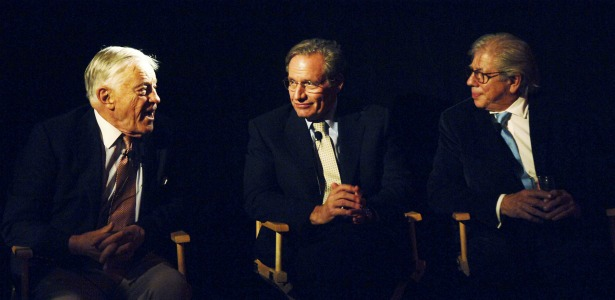
Names to know: Editor Ben Bradlee. Reporters Bob Woodward, Carl Bernstein. Below, 2005.