October 9, 2026
Very Light Assignment over weekend: October 9-11. Review Chapter Four Lesson Plan and Chapter Four (Newspapers) in Textbook. Instructor is grading op-eds and midterm essays over weekend.
PS: 12:40 p.m. I shortened the lesson a bit to make studying easier.
Aso here below are links to historical events that I brought up during class.
a) The New Ulm, MN massacre and mass hanging.
b) Racist Indianapolis Star cartoon character and Jim Crow laws. We will have more on this important journalist Ida B. Wells on Monday.
Jim Crow laws legally enforced racial segregation in public restrooms across the American South from the late 19th century through the mid-20th century. Indianapolis: separate schools, and exclusion from public swimming pools. Abominable practices tied to Jim Crow laws — such as ordering people of color to back of bus — or even back of a women’s parade/protest for voting rights.
c) The first big women’s march (led by Susan B. Anthony) for the vote occurred July 4, 1876.
e) Apartheid (term referred to in class regarding 2026 Nobel Peace Prize winner)
Current Events:
Members of the Anchorage Assembly want to end sales of kratom, a legally dubious cluster of products commonly sold at gas stations, vape shops and online.
On Wednesday, the Assembly’s Public Safety Committee revieweda proposed ordinance that could add misdemeanor penalties for selling or recreationally using kratom and associated products to city laws.
“Alaska and Anchorage are behind the rest of the country to regulate or prohibit kratom products, but the manufacturers and retailers are here,” states a memorandum in support of the ordinance. “It is important to act now before kratom products become an epidemic in the Municipality.”
October 8

STOCKHOLM, Oct 8 (Reuters) – Canadian poet and writer Anne Carson, whose work often blends verse, prose, dialogue and translation in a genre-defying mix, won the 2026 Nobel Prize in Literature on Thursday for what the Swedish Academy called her “bold and inventive oeuvre.”
“Crazy, I think they’re all crazy,” Carson ?told Icelandic broadcaster RUV when asked how she was feeling after learning she had won while on the Arctic island. “I’ll get a sticker on the front of my book.”
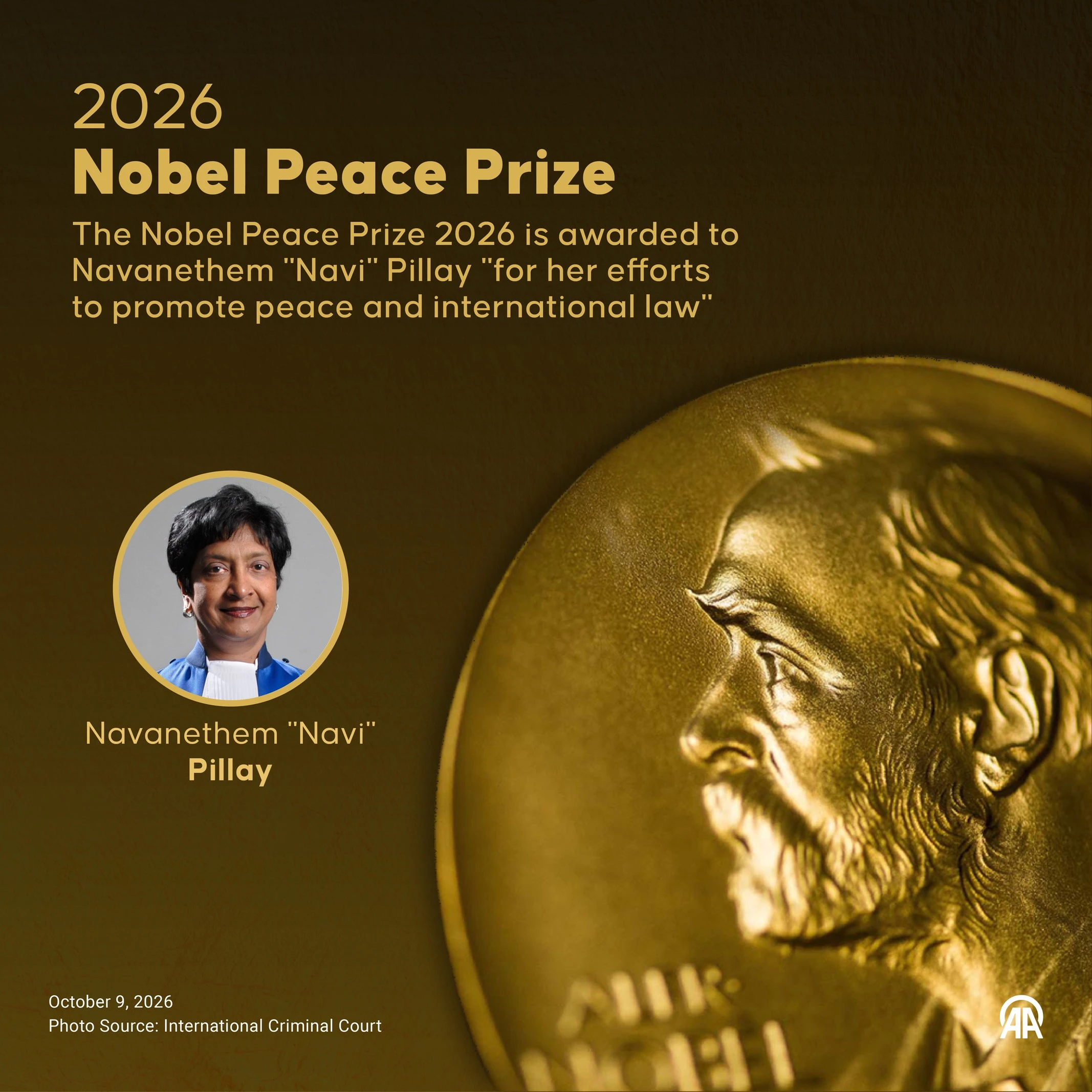
The 2026 Nobel Peace Prize has been awarded to South African lawyer and jurist Navanethem “Navi” Pillay. The Norwegian Nobel Committee recognized her for her lifetime work promoting peace, human rights, and international law.
Jonathan Blitzer, who covers immigration for The New Yorker, cliams ICE arrests have now reached record highs—and about how agents, many of whom are still wearing masks despite lawmakers’ demands that they stop, are acting with impunity at hospitals, airports, and outside schools. “It has taken the Trump Administration less than two years,” he writes, “to make violent encounters with federal immigration agents a regular fact of American life.”
Nate Raymond (Reuters) – A federal judge on Monday blocked efforts by the Trump administration to impose fines of up to $1.8 million on migrants who fail to leave the US ?after receiving final deportation orders.
US District Judge George O’Toole in Boston issued the ruling, opens new tab in a class-action lawsuit filed last year by two of the thousands of migrants who have been assessed civil penalties by the Department of Homeland Security.
_____
News from the Anchorage Press
A recent ICE arrest in Anchorage reflects another national trend, detaining immigrants at airports — in this case, an 18-year-old University of Alaska Fairbanks student after her plane touched down in Anchorage last month.
The student was arrested at Ted Stevens Anchorage International Airport on Sept. 22, according to an ICE spokesperson. She is a Panamanian-Russian dual national who graduated from Alaska Middle College School in Anchorage and is a sophomore at UAF majoring in physics,according to details provided by ICE and UAF.The teenwas held that night at the Anchorage Correctional Complex, a mostly male facility, and transferred to Hiland Mountain Correctional Center for women the next morning, according to the Alaska Department of Corrections.
After posting a bond, the student was released, according to ICE. The student, whose name is being withheld at the request of her family, entered the United States legally in July 2023 and was supposed to leave by May 2024, according to ICE. Her current immigration status, including whether she is seeking asylum or pursuing permanent U.S. residency, could not be determined.
ICE arrests at U.S. airports are becoming increasingly common. The Transportation Security Administration coordinates with ICE by providing to agents passenger lists that include people who overstay their visas.
The Trail of Tears was the forced relocation and ethnic cleansing of roughly 100,000 Indigenous people by the United States government during the 1830s and 1840s. https://www.archives.gov/milestone-documents/jacksons-message-to-congress-on-indian-removal
Link to President Andrew Jackson, the president most notably linked to genocide of Native peoples. Know the term genocide, please.
Chapter Four: Part Two
Know that many of the Cherokee
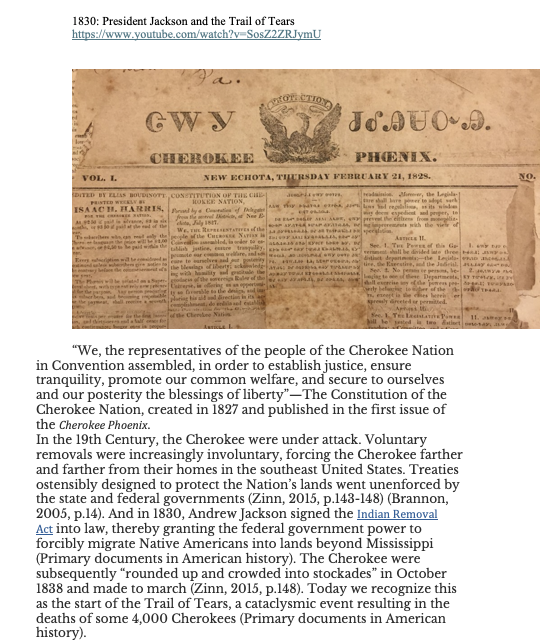
Hartford Courant: Jan. 3, 1832, p. 2. Editorial Objecting to treatment of the Cherokee. Exception to the rule.
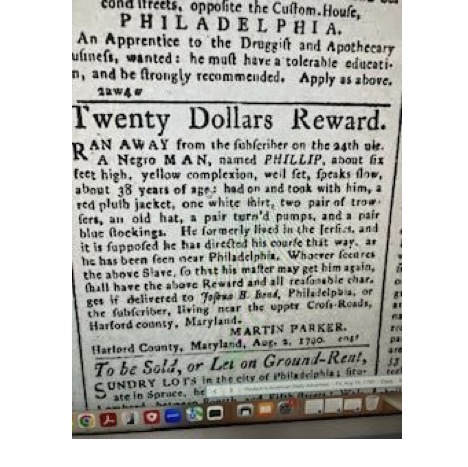
Newspapers North and South often supported slaveholders and accepted without question ads for a bounty on runaway slaves.
Role of newspapers in segregation and civil rights
While Indiana legally prohibited segregation in public accommodations in the late 19th century, in practice, Indianapolis often operated under de facto Jim Crow, with widespread discrimination in housing, employment, and social facilities. Despite a 1949 law ending school segregation, the city’s Black residents frequently faced unequal treatment and segregation. SEE BELOW: INSENSITIVITY OF NEWS MEDIA.
https://www.firstsuperspeedway.com/photo-gallery/jim-crow-i
Local, regional, and national newspapers published by Ku Klux Klan organizations and by sympathetic publishers across the U.S. during the 1920s. Also included are several anti-Klan newspapers.
he Call of the North newspaper was a print propaganda tool for the Ku Klux Klan, with national, state, and local reporting on issues of interest to the KKK. The first issue of the four-page, seven-column weekly was published by the Call of the North Publishing Company on July 27, 1923. Its editor was Peter J. Sletterdahl, a former schoolteacher from Hutchinson, Minnesota, using the pen name “Twilight Orn.” Sletterdahl also served as the KKK Grand Dragon for the Dakotas, and was a national Klan organizer, lecturer, and editor.
Though the original Ku Klux Klan, which began after the Civil War, was effectively shut down by the federal Civil Rights Act of 1871, the group re-emerged nationally in a second incarnation in 1915. With a new fraternal organizational structure and a more formal agenda, the KKK spread in the early to mid-1920s, including into the urban areas of the Midwest and West. Rooted in local Protestant communities, it was known for its beliefs in white supremacy and white nationalism and opposition to immigration.
Ten thousand copies of the inaugural issue of the Call of the North were printed, although it is not known how many people actually subscribed. The paper had a strong moralistic tone and positioned the KKK as a force to ba ttle for “the best things in our American civilization.”
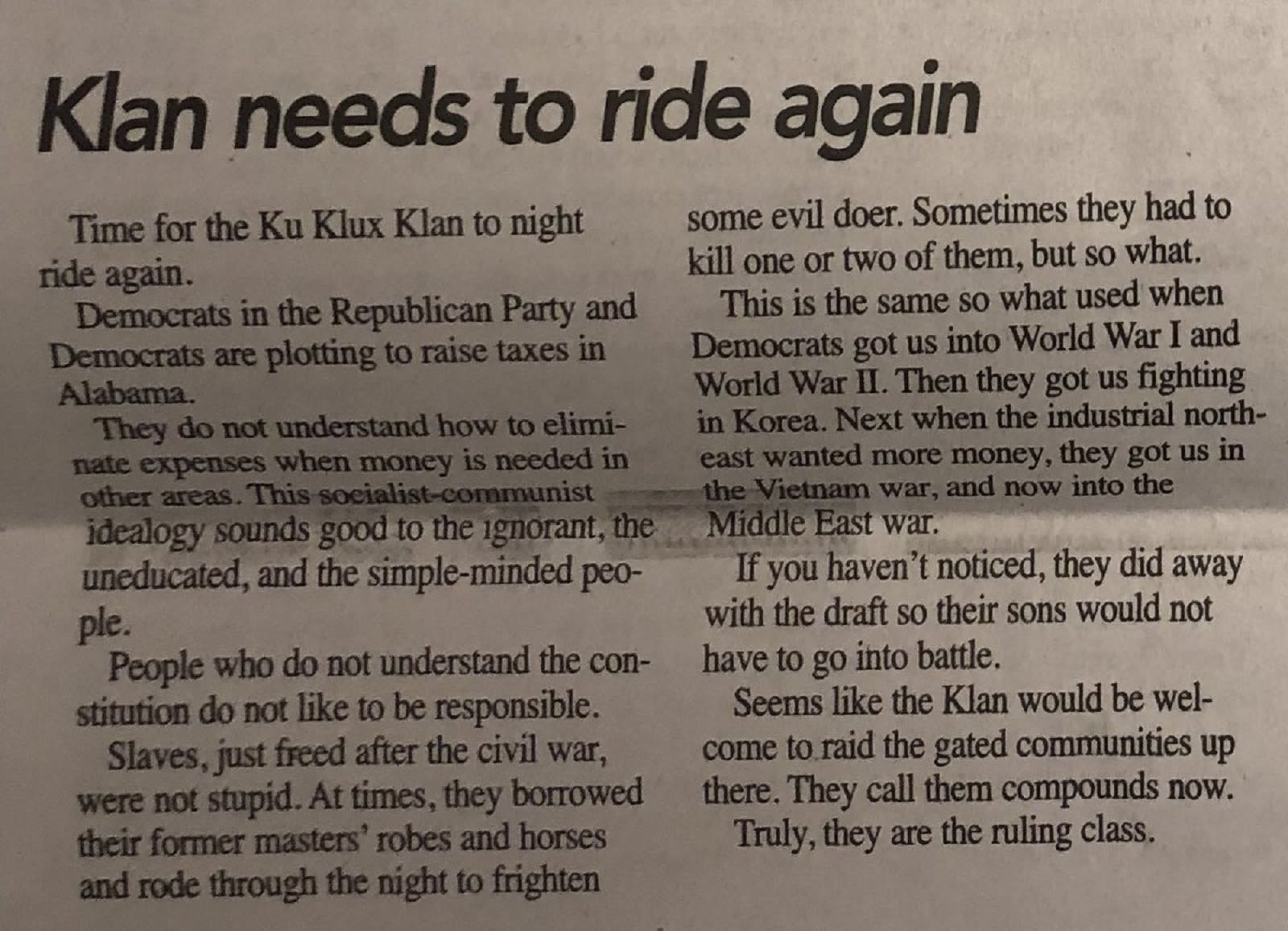
An editorial written in support of the Ku Klux Klan. That’s something you might expect to see in 1919.
Believe it or not, you can see it in 2019, too. The editor and publisher of a small-town newspaper in Alabama wrote one recently.

Goodloe Sutton, editor and publisher of The Democrat-Reporter, in an undated photo.
STAN HONDA/AFP/Getty Images
The editorial, with the shock headline “The Klan Needs to Ride Again,” appeared in the February 14 edition of The Democrat-Reporter in Linden, Alabama.
“Time for the Ku Klux Klan to night ride again,” begins the editorial, written by Goodloe Sutton. “Democrats in the Republican Party and Democrats are plotting to raise taxes in Alabama.”
Sutton confirmed to CNN that he wrote the editorial but declined to provide any additional information.
He told the Montgomery Advertiser he urged the white supremacist group to “clean out D.C.” via lynchings. “We’ll get the hemp ropes out, loop them over a tall limb and hang all of them,” Sutton told the newspaper.
He stressed that he wasn’t calling for the hangings of all Americans, just the “socialist-communists.”
What about Alaska? Likely nothing in 19th Century:
Early Alaska newspapers serving or focusing on Native populations emerged in the early 20th century, with The Alaska Fisherman (1923–1932) serving as an official publication of the Alaska Native Brotherhood. The most significant, later, independent, Native-focused,, and pioneering voice was the Tundra Times (founded 1962), which was crucial for reporting on Native land claims and issues.
Important issues facing Alaska indigenous people today discissed here:
https://alaska-native-news.com/
WOMEN’S ISSUES
Ida Wells: Backing African-American women’s right to vote
Women’s Suffrage and the Media
“Are Women People?” The Poetry of Alice Duer Miller
Alice Duer Miller. “Are Women People?” columns. New York Tribune. 1914-1917.
Era: Suffrage Era | Media:
Alice Duer Miller.

Miller was a Barnard College-graduate who made her mark as a writer for publications like Harper’s and Scribner’s. The line “Are women people?” is the title of a series of pieces she wrote for the New York Tribune, the newspaper owned by the Whig Party advocate Horace Greeley, from 1914-1917, the year New York voted to give women the right to vote.
1913: https://boundarystones.weta.org/2018/01/31/chaos-and-persistence-1913-womens-suffrage-march
SUFFRAGE for Women Voters at long last nationwide: 1920: Following the end of World War ONE:
The Treaty of Versailles was a peace treaty signed on June 28, 1919, in the Hall of Mirrors at the Palace of Versailles, formally ending the state of war between Germany and most of the Allied Powers at the end of World War I.
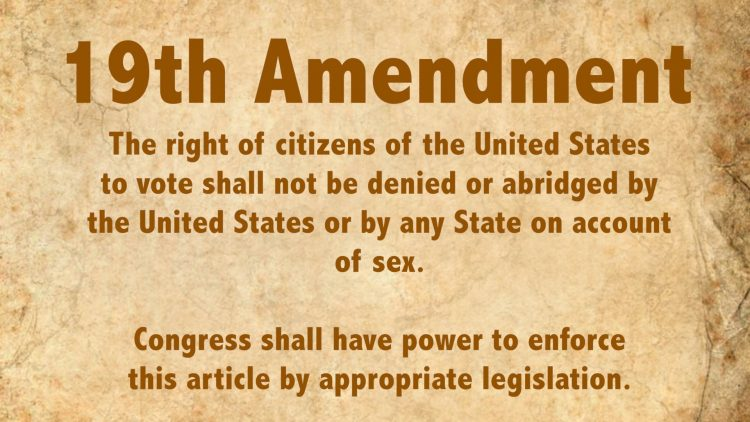
One hundred years ago, on Aug. 18, 1920, the 19th Amendment was ratified, giving women the right to vote (though, as Olivia B. Waxman reported for Time, “most Black women would wait nearly five decades more to actually exercise that right.”)
The Woman Patriot was a prominent national anti-suffrage and anti-feminist newspaper published in Washington, D.C., during the 1920 ratification and aftermath of the Nineteenth Amendment
Newspapers in the late 19th and early 20th centuries often opposed women’s suffrage through anti-feminist articles, editorials, and cartoons, arguing that voting would destroy the home, make women “masculine,” and ignore their “natural” domestic role. Major anti-suffrage publications included The Woman Patriot (formerly Woman’s Protest) and the Anti-Suffrage Review, which promoted the idea that women already had influence through men.
AFRICAN-AMERICAN PRESS
Reminder: Many newspapers failed to hire an African-American reporter until late Civil Rights era.
Reminder: 1905. Most successful of the African-American newspapers. The Chicago Defender served as a cornerstone of the American civil rights movement by exposing racial oppression, mobilizing Black voters, and challenging Jim Crow laws nationwide.
Founded 1905 by lawyer and newspaper publisher Robert Sengstacke Abbott, the Chicago Defender was the most influential black newspaper of the early to the mid-20th century.
During World War I, the Defender became a strong advocate for the equal treatment of black soldiers. It also featured articles contrasting the lives of Blacks in the urban North and rural South, complete with reports of Chicago’s reputation as a city of opportunity. The paper thus played a pivotal role in igniting the Great Migration, a freedom movement of millions of black Southerners who left for points North, Midwest, and West after 1916.