
Categories
Excerpt
This has to be said. College swimmers: stop hazing and initiation drinking events for new members of your teams. Or you’re not going to have a team much longer.
The issue is almost reaching epidemic levels in the sport of swimming over the past few years. This summer/fall alone, three Division I programs were in the news for hazing-related issues.
Dartmouth canceled its entire fall meet schedule and its winter training trip in response to a 2016 event in which the first-year team members were required to create a “sexualized PowerPoint” for their teammates. (Is there a dumber reason to give up half a college swim season than a sexualized PowerPoint? That’s the hill you want to die on?).
East Carolina’s teams went under investigation over alleged hazing activities just last week, and though the teams themselves have been cleared, the school said it could still dole out punishments for specific athletes.
Just this week, Bucknell put it teams back on probation after an initiation event supplied underage team members with alcohol. (Bucknell’s teams were just about to wrap up a previous two-year stint on academic probation for similar reasons, proving that alcohol-based initiation is apparently so important that team members didn’t have the self-control to survive two whole years without it).
And these teams got off relatively easy compared to what we’ve seen.
In 2014, five Virginia swimmers were suspended on allegations of hazing, and later all five were slapped with a lawsuitby a former teammate who says they hazed and threatened him. Drury’s head coach was forced to step back from coaching the team this past winter in response to a former swimmer who says he was hazed so severely it left him unable to swim while suffering from PTSD and Conversion Disorder.
And in 2015, Western Kentucky suspended its entire program for five years, terminating the positions of its entire coaching staff after a Title IX investigation into hazing concerns.
SWIMMING IN A PRECARIOUS POSITION
That Western Kentucky program isn’t coming back, folks.
At least, that’s the sentiment among a number of onlookers. By 2020, the school will have a choice. Option 1: a lengthy search process to hire up to 6 new coaches, who will then start completely over with an entirely blank roster, hoping to recruit enough swimmers just to fill a lineup in year 1 and with at least three or four years before having any sort of competitive chances. Option 2: electing not to resurrect the program and saving a few million dollars in the process.
Swimming is in a horrifically dangerous position at the college level, and would-be hazers need to realize it. College swimming programs across the nation are dropping like flies.
Colleges and universities around the country are battling underground or “rogue” off-campus groups that act as a substitute for traditional Greek life but often without any oversight.
The problems the groups pose surfaced last month when American University in Washington, D.C., expelled 18 students associated with a so-called underground fraternity, Epsilon Iota (EI), in a move that experts on hazing said was unusual if not unprecedented.
“This group has perpetuated and systematically presented a threat to the safety and well-being of our students,” Fanta Aw, the university’s interim vice president of campus life, said in a statement.
American said misconduct findings ranged from “physical violence, hazing and underage drinking, to providing assistance to and perpetuating the activities of an unrecognized group engaged in prohibited conduct.”

Hank Nuwer, a journalism professor at Franklin College in Indiana who has written several books on hazing, said the expulsions were rare.
“I think it’s unheard of,” he said. “I really can’t tell you any other one that has done that.”
He said universities usually make such a move only after an “immediate crisis,” such as the death of a student.
Recent deaths linked to hazing have renewed attention on traditional fraternities and sororities. In February, Timothy Piazza, a pledge at Penn State University, died after an alcohol-fueled party, and last week a freshman at Louisiana State University died in what authorities called a “potential hazing incident.”
But problems surrounding hazing in off-campus groups present another challenge. Nuwer said there are two main types of underground groups: those that began as sanctioned organizations but lost that status after “running afoul of the university” and those created by students who hadn’t previously had a relationship with a Greek letter organization.
Emily Pualwan, executive director of HazingPrevention.org, a nonprofit that works to prevent hazing, said there no formal database tracked “either underground groups or those who have lost their sanction and continue to operate.”
“Many are discovered when an incident occurs and it is reported in the news, or after a death,” she said.
The very nature of these unsanctioned groups can make them especially troublesome for universities, said Norm Pollard, dean of students at Alfred University in upstate New York and a board member at HazingPrevention.org.
“What’s really problematic is they have no affiliation with an external oversight group, so they don’t have a structure of accountability,” he said.
The national fraternity Alpha Tau Omega suspended its Epsilon Iota Chapter at American University in 2000 over violations of hazing and alcohol rules, the university said. American formally withdrew recognition of the fraternity in 2001.
But former members of the fraternity created EI in 2002 — and since then, the university has received reports linking members to reports of rape, sexual assault, hazing, drug use and underage drinking, it said.
Related: Judge in Penn State Hazing Death Dismisses Felony Charges

Sept. 1: Judge in Penn State Hazing Death Dismisses Felony Charges 1:44
“With underground groups, it’s typically purely social,” Pollard said. “It’s a secret organization without adult oversight, involvement without assistance of the university or college office of Greek life, so they’re engaging in a lot of extreme behavior without very much regulation, unfortunately.
“When fraternities and sororities work well, it’s a great learning opportunity,” he added. “Social experience and leadership and those things are lacking when they go rogue on their own.”
American has been warning students about EI since its inception and even cautions incoming freshmen in its summer orientation programs.
But universities have struggled to discipline students in these groups because they aren’t officially recognized, often operate off campus and can be secretive in their membership and activities, Pollard said.
And students have a right to free association, so schools often can’t discipline members until a specific complaint is filed, Nuwer said.
Related: Do Penn State’s Reforms After Hazing Death Go Far Enough?
For example, the alcohol-related death of freshman Everett Glenn led Lafayette College in Easton, Pennsylvania, to ban students from joining unrecognized fraternities and sororities.
And in 2014, Amherst College in Massachusetts banned students from participating in underground groups after allegations surfaced that the school had mishandled a high-profile sexual assault case. Amherst did away with its fraternity system in 1984, but underground groups appeared in its wake and were allowed to exist off campus.
While these groups aren’t subject to direct oversight, students at most schools are still governed by a code of conduct determined by the administration. Once a complaint is filed, colleges can take steps to amend their policies to include off-campus organizations.

Sept. 1: Family of Penn State Student Hope Hazing Death Sends Message 0:45
In 2016, American University amended its student code to prohibit “providing assistance to or in any way perpetuating the activities of an Underground Group that violates the Code and/or other university policies.”
The University of Pennsylvania said this year that it would identify off-campus groups, update anti-hazing regulations to include unregistered groups and require those groups to provide the school with contact information of its leaders and membership rosters. The move followed an incident in which an underground fraternity sent a sexually suggestive invitation to an off-campus party to freshmen women, according to The Philadelphia Inquirer.
Part of the guidelines call for making it clear “that hazing is prohibited in any organization, regardless of whether the group is registered with the University” and regardless of where the event takes place.
Nuwer added that beyond underground groups, hazing in sanctioned “model” fraternities and sororities left students especially at risk.
Related: Why Did No One Call 911 After Pledge Timothy Piazza Got Hurt?
“The chapters that lie, like in Penn State with Beta Theta Phi that had a great reputation, are more dangerous than the underground, where everybody knows they’re bad,” he said, because they are “doing illegal things behind closed doors but are doing so under a cloak of respectability.”
After the death of Timothy Piazza, 19, after an alcohol-fueled pledge event at a fraternity house, Penn State President Eric Barron said, “All indicators suggested Beta Theta Phi was a model fraternity.”
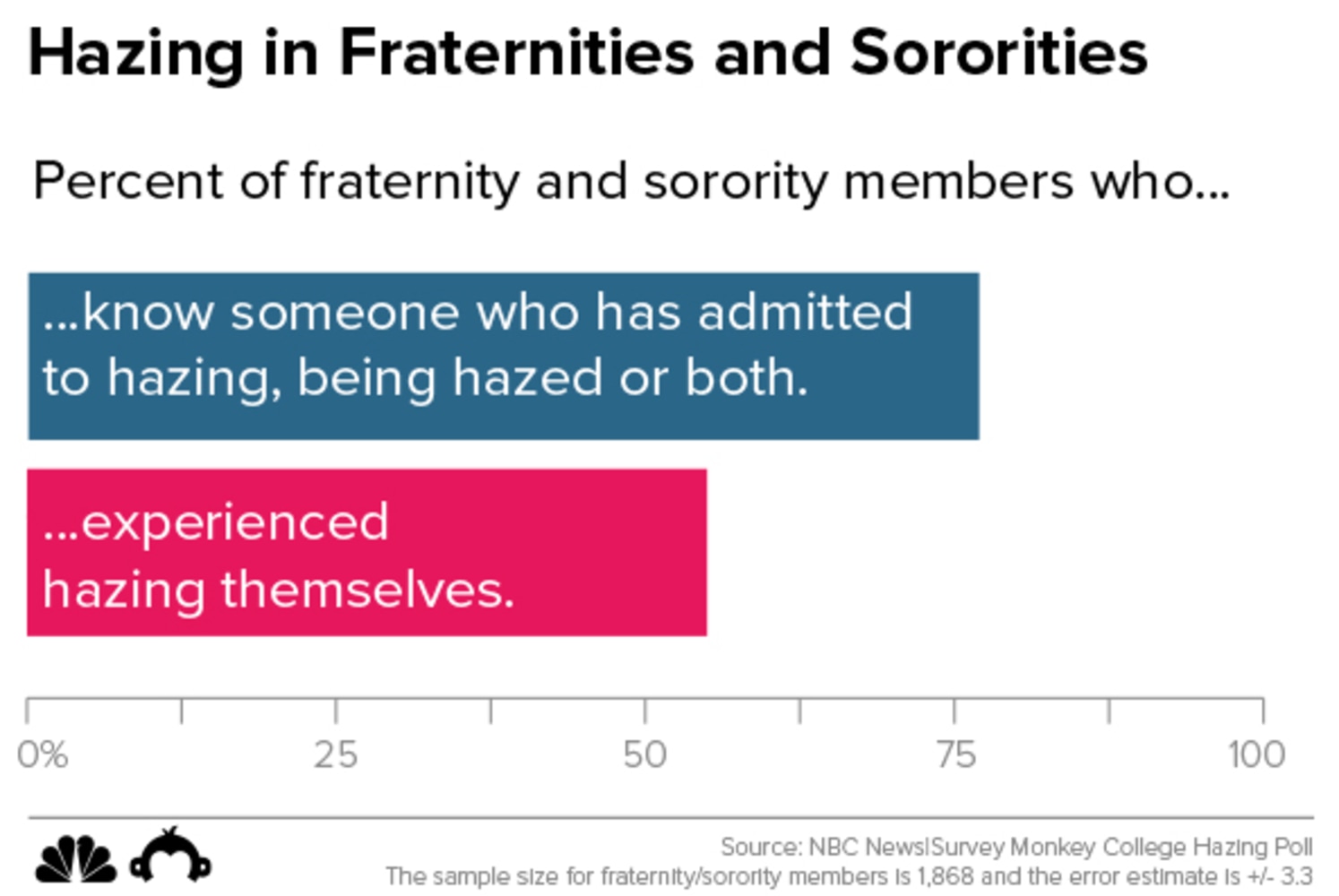
Seventy-seven percent of fraternity and sorority members said they know someone who has admitted to hazing, who has been hazed or both, according to an NBC News|SurveyMonkey poll. And 55 percent of those who were members of fraternities or sororities said they had experienced hazing themselves.
Piazza’s death led to a series of changes. Penn State shut down the Beta chapter, which was an officially recognized group, and the Beta Theta Pi International Fraternity suspended the group.
Nuwer, who tracks hazing-related deaths, said his research showed that there has been at least one death a year in U.S. schools from 1961 to 2017.
“I really don’t see an end in sight at this stage,” he said.
With universities cracking down on both rogue and recognized groups and with new students coming in every year, Pollard said, continual monitoring and enforcement are necessary for lasting change.
“Students are coming sometimes from a hazing experience in high school, so there’s a level of familiarity that they may have,” Nuwer said. “Then they get to college and introduce alcohol, and hazing can turn deadly.”
The NBC News|SurveyMonkey poll was conducted online from Sept. 5 through 11 among a national sample of 10,408 adults. Respondents for this non-probability survey were selected from the nearly 3 million people who take surveys on the SurveyMonkey platform every day. Results have an error estimate of plus or minus 1.4 percentage points. For full results and methodology, clickhere.
Moderator: The condition that the killers of Horacio Castillo III just turns one’s stomach.
Hazing, the weed in the Garden of Eden that suffocates us all
By Hank Nuwer, copyright TheStatehouseFile.com opinion writer (Updated July 29, 2019)
While colleges across the country are finding creative ways to celebrate National Hazing Prevention Week Sept. 18-22, I’ve managed considerable progress on my goal to create a database of every hazing incident reported in the media from colonial days to the present.
The present database has come a long way from the database I published in my 1990 book, “Broken Pledges,” using Lexis-Nexis data. Up to now, most major media outlets have cited my database of hazing deaths that showed the U.S. experienced at least one hazing death per year 1959 to 2019.
As of this column, that figure is out of date thanks to research performed for my Indiana University Press investigative book, “Hazing: Destroying Young Lives.”
The new database at http:hanknuwer.com now shows one death per year in U.S. colleges, secondary and elementary schools from 1959 to 2019. Think of 1959. JFK was battling Richard M. Nixon for the presidency. Fidel Castro was determined to rule Cuba. My beloved Alaska (I own 20 acres there) was admitted with Hawaii to the union.
Some years many deaths occurred, not just one. Although there were no U.S. deaths recorded in 1958, there was an annual death from 1954 to 1957.
In addition, I counted a relatively small, though disturbing, number of hazing deaths over the years in Boy Scouts, Masonic organizations, the Knights of Columbus, and the U.S. Armed Forces. The story of how Benjamin Franklin in 1737 momentarily tarnished his reputation by failing to stop a dangerous hazing prank is the first incident in this database.
Behind every death is a family torn apart by the loss of a loved one who was strangled by alcohol, beaten to death, struck by a car while blindfolded, drowned, and so on. The first fraternity death, that of Mortimer Leggett, son of a famed Civil War general with the same name, occurred at spanking new Cornell University in 1873. Young Leggett fell off a cliff on a required midnight walkabout while wearing a blindfold in gorge country.
Then there is the proctor who got sick and tired of being hazed at Swarthmore College and grabbed a flashlight and rifle to slay one tormentor as he slept. The hazer escaped the electric chair with an insanity plea.
There was the recent death of Clemson pledge Tucker Hipps. Hipps died when he fell from a bridge at Lake Hartwell. His was the second Clemson fraternity death at that lake. No reporter, including me, reported that fact until a new keyword search came up with another tragedy at Clemson in 1961—the first year of what would become 56 consecutive years with a hazing death.
Stashed among thousands of news clippings about hazing are earnest appeals from educators, grieving parents, activists and earnest students to do away with this “weed in the garden of academe” as one pundit called it in an 1860 speech at Harvard.
But the problems of hazing in 1860 are the same now, but the perpetrators are a lot more careful to hide their tracks, to lie or to stonewall investigators, and to intimidate anyone threatening to come forward with the truth.
I’ve met dozens of the hazed and hazers alike, the families of the dead, the dedicated Greek professionals, a lot of jaded alums, and activists from HazingPrevention.org,Stophazing,org, the AHA Movement and so on. Many parents who gave years of service to the cause have quit, so disillusioned by the continuing string of deaths that they no longer can even utter the word “hazing.” Fortunately, the new organization PUSH has parents who will say they are activists forever.
Everything possible has been tried. Bystander training. Help Weeks instead of Hell Weeks. Associate memberships instead of pledges. Delayed rush. Yanking charters.
But still the deaths continue. I want to assure you there will be no more dangerous hazing when my friend John’s son goes to college in a year or, closer to home, my grandson in a couple more years.
But I can’t.
My list of deaths gets longer, longer and still longer.
Stopping hazing is easy, I tell students. “Just don’t do it.”
But too many don’t listen.
Hank Nuwer is a Franklin College journalism professor and the author of “Hazing: Destroying Young Lives,” “The Hazing Reader,” “Wrongs of Passage” and many other books.